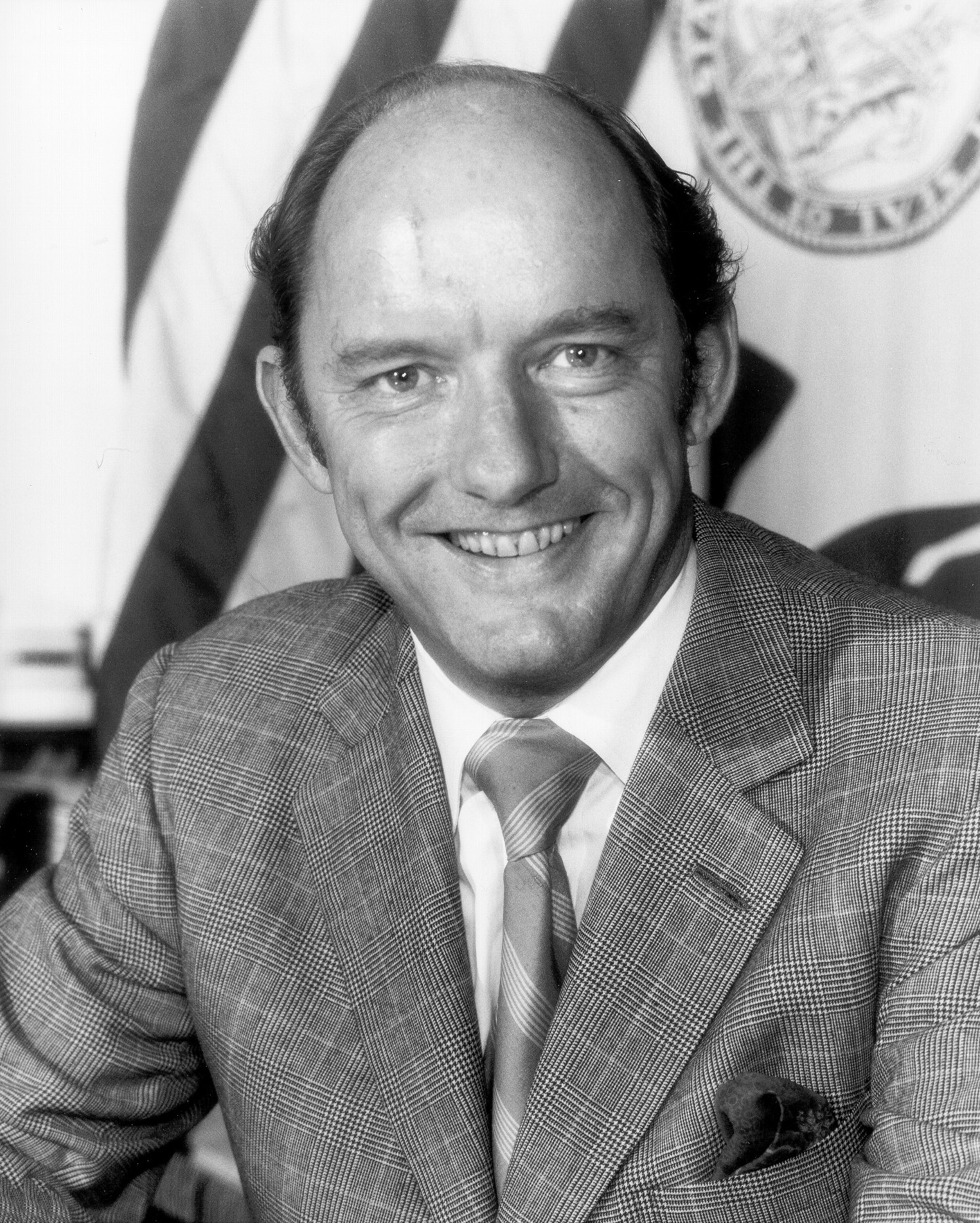
When he runs for the Senate in 1976, no one initially gives State Senator Malcolm Wallop (1933-2011) a chance against three term incumbent Gale W. McGee. McGee had been a war hawk on Vietnam but was largely a domestic liberal (oil was an exception) who had opposed efforts to ease OSHA regulations on small businesses and supported environmental legislation seen as intrusive to many Wyoming voters. Wallop had previously run for the Republican nomination for governor in 1974 and took a bit of a pro-environmental stance and lost. A number of Republicans were frustrated at him for his perceived lukewarm support of the primary winner, who lost the general election. Polling in the months before the election showed McGee at 72% with Wallop at only 18% and his seat was commonly thought of as safe, but Wallop runs a campaign condemning his votes in support of legislation regulating small business (namely, OSHA) and an EPA many people in Wyoming regard as overbearing. His master class ad spots (see the link in References) contribute to his victory by nine points, a 63-point swing, on Election Day. Gale McGee to this day is the last Democrat to represent Wyoming in the Senate.
Senator Wallop
Wallop is initially staunchly conservative on economics with a couple liberal votes on social issues. For instance, there were multiple occasions in which he voted to maintain Medicaid funding for abortion and he wasn’t gung-ho about the death penalty. But Wallop’s promotion of deregulation, pushing back against overly intrusive government, and his push for lower taxes by far outdid any liberal spots he had early in his Senate career.
Height of Power: The Reagan Years
During the Reagan Administration, Wyoming, with Wallop as well as Senator Alan Simpson and Representative Dick Cheney were a powerhouse in Washington D.C., carrying a great deal more influence with Reagan than would be expected of the least populated state in the U.S. As fellow Wyoming Senator Alan Simpson stated, “It was said that was the most powerful delegation pound for pound in Washington, and I’m sure we didn’t let it go to our heads” (Moen). Wallop was active in pushing for the Strategic Defense Initiative as well as fighting communism in Central America, and his bill to cut inheritance and gift taxes was incorporated into the Kemp-Roth tax reduction in 1981. He also helped bring an end to the windfall profits tax imposed during the Carter Administration. Wallop was effective and packed a legislative punch, so to speak. As colleague Alan Simpson recalled of him, “He had rare legislative skills, and his friendship meant a great deal to me…He did his homework and he had a powerful command of English. As a legislator, he was a devastating debater because of his command of language” (Pelzer). In 1981, as chairman of the Senate Ethics Committee, he presided over the Senate response regarding Senator Harrison Williams’ (D-N.J.) part in the Abscam Scandal.
In 1984, Wallop, whose grandfather Oliver Henry Wallop, was the Earl of Portsmouth, hosts Queen Elizabeth II and Prince Phillip for four days at his ranch in Big Horn, Wyoming as part of their American visit. That year, he sponsors legislation with Sen. John Breaux (D-La.) to form the Wallop-Breaux Trust Fund, which funds state fishery and boating programs (Pelzer).
Wallop moves to the right throughout his time in the Senate and is not afraid to stand in the overwhelming minority; in 1988 he is one of only five senators to vote against the INF Treaty and in 1990 he votes against the Americans with Disabilities Act. In 1994, Wallop calls it quits, this possibly having to do with him coming close to losing reelection in 1988 (he had in 1976 promised to run for two terms), even as George H.W. Bush won the state by 22 points. A report in The Economist noted about his controversial nature, “Although his detractors have steadily grown in number, even Democrats grudgingly admitted to liking his candor and his willingness to be stupendously politically incorrect” (Fox).
After the Senate and Death
After leaving the Senate in 1995, Wallop founds Frontiers of Freedom, a conservative advocacy group. The following year, he chairs Steve Forbes’ candidacy for the Republican nomination for president, and although he wins the Arizona and Delaware primaries, Bob Dole wins the nomination. Sadly, his final years were marked by advanced Parkinson’s Disease and coronary disease, and he died on September 14, 2011 (Pelzer). Wallop’s lifetime MC-Index score is a 95%, while DW-Nominate scored him a 0.575. For his contributions to tax reduction, national defense, and expanding trade as well as his conservative voting record and his general political incorrectness, he earns his place.
References
Fox, M. (2011, September 16). Malcolm Wallop, Senator From Wyoming, Dies at 78. The New York Times.
Retrieved from
https://www.nytimes.com/2011/09/16/us/malcolm-wallop-ex-senator-of-wyoming-dies-at-78.html?_r=1
Malcolm Wallop for U.S. Senate Wyoming 1976 TV Ad. YouTube.
Retrieved from
Moen, B. (2011, September 14). Former Wyo. US Sen. Malcolm Wallop dies at age 78. The San Diego Union Tribune.
Retrieved from
Pelzer, J. (2011, September 15). Former three-term Wyoming U.S. Sen. Wallop dies. Casper Star Tribune.
Retrieved from
 Mad Politics: The Bizarre, Fascinating, and Unknown of American Political History