Although the 1950s is often thought of as a period of moderate Republicanism and with some good reason, by Americans for Constitutional Action standards, conservatives reside primarily on the Republican side of the aisle. Southern Democrats are particularly weak on public works, the Tennessee Valley Authority, and agriculture issues. However, on issues of organized labor, education, spending, and permitting state anti-subversive laws, there is substantial Southern Democrat support for conservative positions. There were 9 votes counted for 1957, 12 for 1958, 19 for 1959, and 10 for 1960.
Civil rights do not yet appear as an issue for Americans for Constitutional Action in the House, but agriculture votes figure significantly in the 85th Congress, with five of twenty-one votes being inherently agricultural. There is also a vote on establishing a food stamp program, which does fall into typical liberal-conservative splits and has relation to agriculture. Thus, radical Adam Clayton Powell’s (D-N.Y.) higher-than-expected scores at 25% in 1957, 44% in 1958, 13% in 1959, and 13% in 1960 and some lower-than-expected scores among Southern Democrats. Per ACA, in the second term of Eisenhower’s presidency, Republicans were overall on domestic issues quite a conservative group. In 1959 in particular, scores are quite elevated for Republicans; Gerald Ford (R-Mich.) scores his one and only 100% by the group that year, as do Republicans Howard W. Robison and Charles Goodell of New York, both who would be noted for their ideological turns later, with the latter being a far more dramatic case than the former. In that year as well as 1958 there are no foreign aid votes counted.
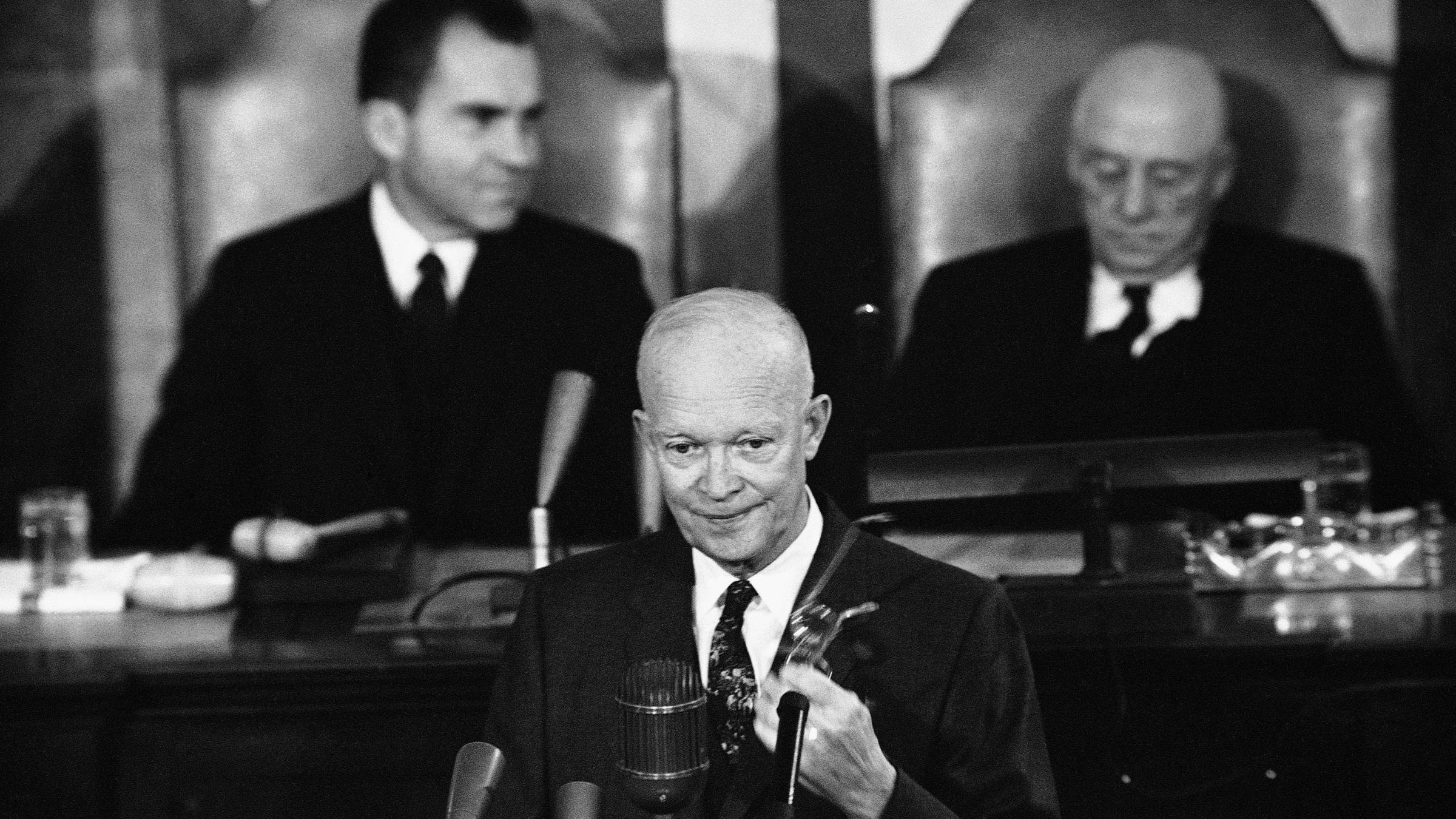
The GOP’s leader in the House, Joe Martin of Massachusetts, scores a 56% in 1957 and an 89% in 1958. Three of his five votes against the conservative position in that session are on foreign aid. He in the 86th scores an adjusted 93% in 1959 and an adjusted 33% in 1960. This is counting pairs for and against legislation. Although this wasn’t ACA’s practice, it is a more complete ideological judgment. Martin’s successor, Charles Halleck (R-Ind.), gets a 63% in 1957, a 92% in 1958, a 94% in 1959, and a 70% in 1960. If we are to count officially announced positions from President Eisenhower on votes, he scores a 14% in 1957, a 67% in 1958, a 92% in 1959, and a 57% in 1960. Averaging these out gives Eisenhower a 58%, which is consistent with the popular historical view of him as a moderate. I see these scores as reflecting a conservative view on what was important in the 1950s, and there are certainly some differences than with Americans for Democratic Action. Trade votes do not figure in the ACA’s scoring during the latter part of the Eisenhower presidency. Also not included are votes regarding the Mallory rule of evidence and statehood for Alaska and Hawaii.
I would evaluate the Senate as well, but I haven’t cracked the breakdown of the scores yet. The Senate is considerably harder to do than the House, because there are far more unique votes there that can effectively rule out more votes in this process of deduction.
The members of Congress who did no wrong by Americans for Constitutional Action by adjusted scores in the 85th Congress included:
H. Allen Smith, R-Calif.
Edgar Hiestand, R-Calif.
Glen Lipscomb, R-Calif.
James B. Utt, R-Calif.
E. Ross Adair, R-Ind.
Charles Brownson, R-Ind.
Howard W. Robison, R-N.Y.
John R. Pillion, R-N.Y.
Gordon Scherer, R-Ohio
William Minshall, R-Ohio
The members of Congress who did no wrong by them in the 86th Congress by adjusted scores were:
H. Allen Smith, R-Calif.
Hamer Budge, R-Idaho
Elmer J. Hoffman, R-Ill.
Noah Mason, R-Ill.
August Johansen, R-Mich.
Clare Hoffman, R-Mich.
Gordon Scherer, R-Ohio
Clarence J. Brown, R-Ohio
Samuel Devine, R-Ohio
Frank Bow, R-Ohio
Bruce Alger, R-Tex.
Richard Poff, R-Va.
Descriptions of Votes
Key for Votes:
+ – A vote for ACA’s position.
– A vote against ACA’s position.
+ – A pair or announcement for ACA’s position.
– – A pair or announcement against ACA’s position.
? – No vote.
The Votes:
1957 ACA-Index, House:
1958 ACA-Index, House:
1959 ACA-Index, House:
1960 ACA-Index, House:
 Mad Politics: The Bizarre, Fascinating, and Unknown of American Political History