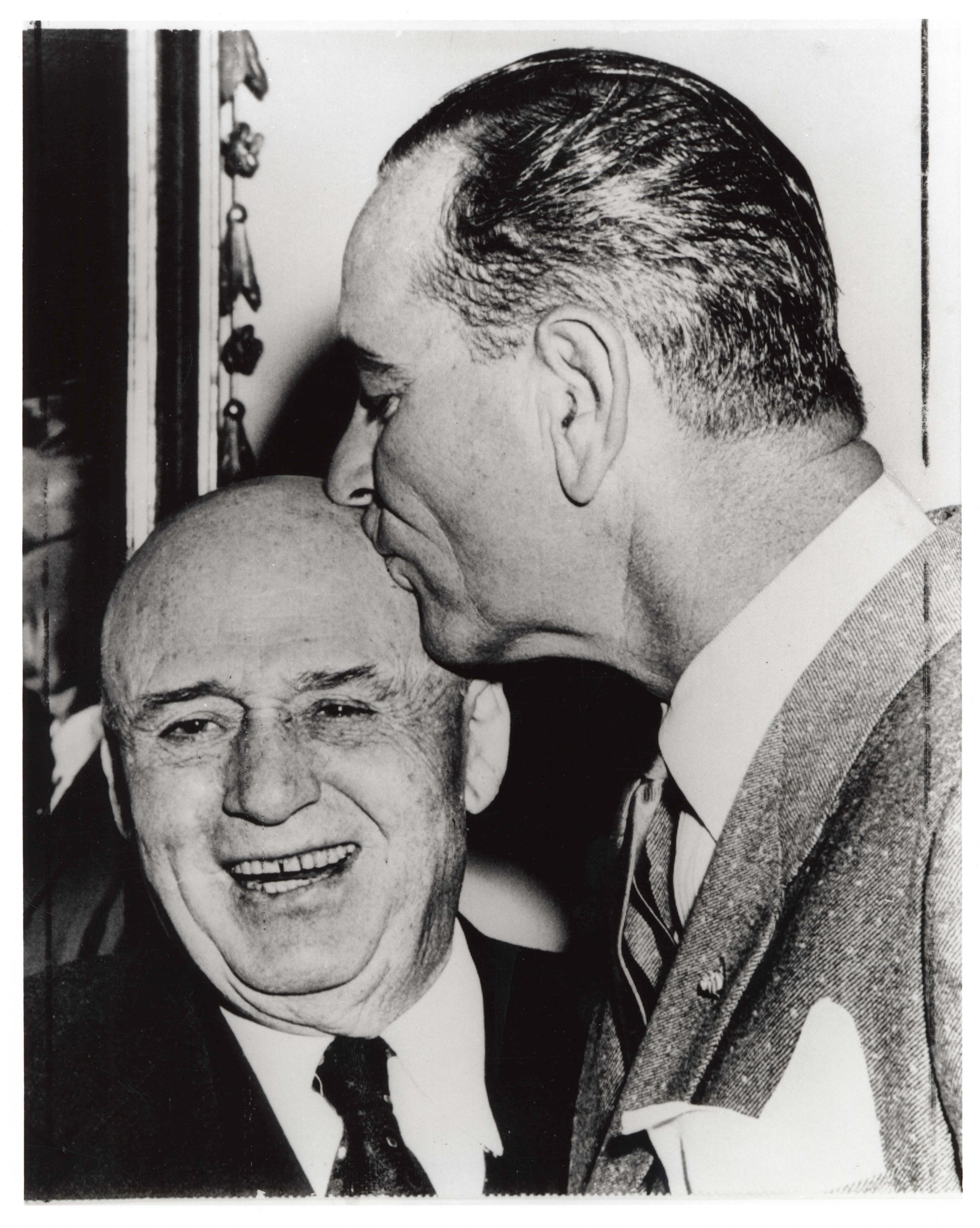
The victorious Democratic leaders: Speaker Sam Rayburn & Majority Leader LBJ.
The 1958 midterms don’t usually get a whole lot of attention, but they were in truth quite a turning point for conservatism vs. liberalism. The 1950s have been seen as a politically conservative period, which had at least been true in Congress. Conservatives had considerable strength for the past two decades, with it being particularly strong in the 78th, the 80th, and the 82nd and 83rd Congresses. In the Senate, the Democrats had only a 49-47 majority before this election, and after they had a commanding 62-34 lead, only to turn into a 65-35 lead after the addition of Alaska and Hawaii to the Union. This was the most severe blow the Conservative Coalition had experienced since its rise in the 1938 midterms and would set the stage for the liberal politics of the 1960s.
The following Senate seats either had Republicans defeated or retiring Republicans were succeeded by Democrats:
California – William Knowland (R) (MCI: 71%) retired to run for governor, succeeded by Rep. Clair Engle (D) (MCI: 22%).
Connecticut – William Purtell (R) (MCI: 61%) was defeated for reelection by former Rep. Thomas Dodd (D) (MCI: 19%).
Indiana – William Jenner (R) (MCI: 96%) retired, Vance Hartke (D) (MCI: 10%) defeated Harold W. Handley (R) to succeed him.
Maine – Frederick Payne (R) (MCI: 52%) was defeated for reelection by Governor Edmund Muskie (D) (MCI: 5%).
Michigan – Charles Potter (R) (MCI: 75%) was defeated for reelection by Phil Hart (D) (MCI: 1%).
Minnesota – Eugene Thye (R) (MCI: 57%) was defeated for reelection by Rep. Eugene McCarthy (D) (MCI: 2%).
Nevada – George Malone (R) (MCI: 84%) was defeated for reelection by Howard Cannon (D) (MCI: 37%).
New Jersey – H. Alexander Smith (R) (MCI: 63%) retired, former Rep. Harrison Williams (D) (MCI: 6%) defeated Rep. Robert Kean (R) to succeed him.
Ohio – John W. Bricker (R) (MCI: 98%) was defeated for reelection by former Rep. Stephen Young (D) (MCI: 18%).
Utah – Arthur Watkins (R) (MCI: 86%) was defeated for reelection by Frank Moss (D) (MCI: 10%), who benefited from the entry of Republican J. Bracken Lee, who ran as an Independent to Watkins’ right and won 26.4% of the vote.
West Virginia – W. Chapman Revercomb (R) (MCI: 84%) was defeated for reelection by Rep. Robert Byrd (D) (MCI: 28%), John Hoblitzell (R) (MCI: 76%) was defeated for election to a full term by former Rep. Jennings Randolph (D) (MCI: 25%).
Wyoming – Frank Barrett (R) (MCI: 87%) was defeated for reelection by Gale W. McGee (D) (MCI: 17%).
The following Senate seats had retiring Republicans succeeded by more liberal Republicans:
Pennsylvania – Edward Martin (R) (MCI: 90%) for Rep. Hugh Scott (R) (MCI: 53%), who defeated George M. Leader (D).
Vermont – Ralph Flanders (R) (MCI: 62%) for Rep. Winston Prouty (R) (MCI: 56%), who defeated Frederick J. Fayette (D).
Additionally, with the two states of Alaska and Hawaii being added to the union, the following senators were elected:
Alaska
Bob Bartlett (D) (MCI: 14%)
Ernest Gruening (D) (MCI: 16%)
Hawaii
Oren Long (D) (MCI: 5%)
Hiram Fong (R) (MCI: 52%)
Among the defeated or retired who were solid or ultra-conservatives were Jenner, Malone, Bricker, Martin, Watkins, Revercomb, and Barrett. Moderate conservatives defeated or retired were Knowland, Potter, and Hoblitzell. The moderates defeated or retired were Purtell, Payne, Thye, Smith, Ives, and Flanders. Every senator who defeated or succeeded another senator, with the exception of replacing Irving Ives (MCI: 47%) with Kenneth Keating (MCI: 54%), was more liberal and often considerably more liberal than his predecessor. Every single one of the new senators would support the Economic Opportunity Act of 1964 and Medicare and all won reelection in 1964 save for Kenneth Keating, who lost reelection to RFK, and Clair Engle, who died of a brain tumor. Democrats adding 15 seats provided a solid liberal base in the Senate for over two decades. Particularly notable was the defeat of Payne in a state that had previously had a registration ratio of 3 to 1 Republican…his opponent Edmund Muskie had as governor made massive inroads with voters for the Democratic Party (U.S. Senate).
The House: A Triumph for Liberalism
The Democrats increased their lead in the House from 234-201 to 283-153 lost 48 seats, which solidified their position in the majority until 1994. Democrats won a lot in the Midwest, gaining three seats in Illinois, six in Indiana, three in Iowa, two in Kansas, one in Michigan, two in Nebraska, one in North Dakota, three in Ohio, and two in Wisconsin. In New England, they defeated all six Republican representatives in Connecticut, won a seat in Maine, won a seat in Massachusetts, and won a seat in Vermont. The latter result was particularly jarring as William Meyer was the first Democrat to win an election to Congress from the state since before the Republican Party’s founding in 1854. This would be a temporary victory for them, as Rockefeller Republican Robert Stafford would defeat him in 1960, but it would prove a portend of the future. In Massachusetts, Republican Richard Wigglesworth was succeeded by Democrat Jimmy Burke, a hilariously shameless figure on spending and taxes who I’ve written about before (but from an electoral standpoint, was he wrong?). The seat would never again be held by a Republican. Also, the two Republicans (Silvio Conte and Hastings Keith) who kept seats being departed by retiring Republicans (John Heselton and Donald Nicholson) were more liberal than their predecessors. This election also hit home for President Eisenhower, as his district’s representative, Pennsylvania Republican S. Walter Stauffer, lost reelection to Democrat James M. Quigley (Time Magazine).
Another interesting tidbit was that moderate conservative Republican John J. Allen of California narrowly lost reelection to ultra-liberal Democrat Jeffery Cohelan. The district he lost covered Berkley and Oakland. To this day, Allen is the last Republican to represent these cities in Congress and today they are represented by Barbara Lee, one of the most liberal members of Congress.
Gubernatorial Elections
In these elections, Democrats gained a net of six governorships.
Democratic Gains
Alaska – William A. Egan (D) defeated John Butrovich (R) in the state’s first gubernatorial election.
California – Pat Brown (D) defeated Senator William Knowland (R) to succeed Goodwin Knight (R).
Maryland – J. Millard Tawes (D) defeated Congressman James Devereux (R) to succeed Theodore McKeldin (R).
Nebraska – Victor Andersen (R) was defeated for reelection by Ralph Brooks (D).
Nevada – Charles Russell (R) was defeated for reelection by Grant Sawyer (D).
New Mexico – Edwin Mechem (R) was defeated for reelection by John Burroughs (D).
Ohio – C. William O’Neill (R) was defeated for reelection by Michael DiSalle (D).
South Dakota – Ralph Herseth (D) defeated Phil Saunders (R) to succeed retiring Joe Foss (R).
Wisconsin – Vernon Thomson (R) was defeated for reelection by Gaylord Nelson (D).
Wyoming – Milward Simpson (R) was defeated for reelection by John J. Hickey (D).
Republican Gains
Arizona – Paul Fannin (R) defeated Robert Morrison (D) to succeed Ernest McFarland (D).
New York – Averell Harriman (D) was defeated for reelection by Nelson Rockefeller (R).
Oregon – Robert D. Holmes (D) was defeated for reelection by Mark Hatfield (R).
Rhode Island – Dennis J. Roberts (D) was defeated for reelection by Christopher Del Sesto (R).
Causes & Consequences:
For causes, the economy was in a recession in 1958, and this led to many Republicans being turned out of office, with President Eisenhower not being popular at the time. Although the primarily worked against Republicans, in New York it worked against Democratic Governor Averill Harriman, who was defeated by Nelson Rockefeller, providing a major boost to the latter’s profile. Another factor was simply the good looks of candidates themselves, as the more attractive candidates were consistently winning (Time Magazine). There was also the perception that the US was behind in the Cold War because of the launch of Sputnik. Also, organized labor was heavily mobilized to turn out for this election, and they did in droves to fight “right to work” proposals in certain states as well as the Eisenhower Administration’s support of such proposals. Such a proposal on the ballot in Ohio was widely believed to be the deciding factor in the defeat of Bricker, who had a history as a popular governor and VP nominee, was previously believed to be unbeatable (Hill).
After this election there were leadership changes in both chambers. In the House, the Republicans voted their leader Joe Martin of Massachusetts out in favor of Charles Halleck of Indiana. In the Senate, William Knowland of California had been their leader, and the Republicans elected whip Everett Dirksen of Illinois in his place although Rockefeller Republican John Sherman Cooper of Kentucky made a spirited run for the post.
The South
Before this time, Northern and Southern Democrats were fairly evenly divided, but with Northern Democrats now outnumbering Southerners by almost two to one, this would distinctly disadvantage them on the direction of the party (U.S. Senate). Most notably, the party would become bolder on civil rights. Among the senators newly elected in 1958, only Robert Byrd of West Virginia would vote against the Civil Rights Act of 1964 and the Voting Rights Act of 1965.
References
Hill, R. John W. Bricker of Ohio. The Knoxville Focus.
Retrieved from
https://www.knoxfocus.com/archives/this-weeks-focus/john-w-bricker-of-ohio/
Mid-term Revolution. U.S. Senate.
Retrieved from
https://www.senate.gov/about/origins-foundations/parties-leadership/1958-midterm-revolution.htm
What the 1958 Elections Mean. Time Magazine.
Retrieved from
https://content.time.com/time/subscriber/article/0,33009,938001,00.html
 Mad Politics: The Bizarre, Fascinating, and Unknown of American Political History